Happy New Beers: A Designer's Review
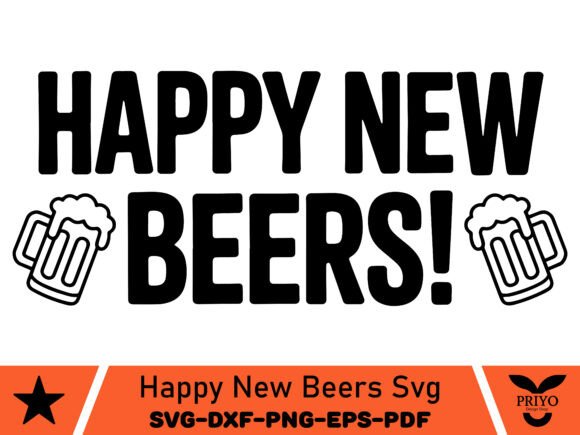
As someone who embroiders both for my own creative satisfaction and for client projects, I’m always evaluating a design with a practical eye. It’s not just about whether it looks good on screen—it’s about how it will translate into thread and fabric, and ultimately, how it feels as a finished product. Today, I’m considering the Happy New Beers SVG, a design that clearly belongs in the Crafts and Graphics world, from the perspective of putting it to real use.
The Immediate Charm: A Casual, Cheery Greeting
The first impression is straightforward and fun. It’s a casual, cheery greeting that immediately suggests celebration and a lighthearted mood. The theme and layout have a friendly, almost hand-drawn personality that feels welcoming rather than formal. This isn’t a sleek, corporate logo; it’s a design meant for personal connection. For an embroidery project, this mood translates perfectly into items meant for gifting, casual wear, or playful decor. I picture it on a cozy sweatshirt for a friend or a tote bag for a brewery visit—it naturally belongs to projects that are about sharing a good time.
Where This Design Stitches Up Perfectly
In practical terms, this design’s versatility, as noted, opens many doors. My mind goes to several real-life scenarios. I recently had a request for a custom embroidered apron for a home brewer—this would have been an ideal contender. The scale and style would work beautifully on that canvas. Similarly, for a small shop selling handmade merchandise, this could become a signature item on a simple beanie or a patch for a jacket. As an Etsy seller or someone stocking a craft fair booth, it’s a design that could easily become a holiday gift staple, embroidered onto a pillow cover or a kitchen towel for a New Year’s Eve host.
For baby embroidery or nursery decor, I’d likely steer away—the theme is specific—but for adult apparel and home goods, it’s spot-on. On a sweatshirt, the text and graphic elements would need to be sized appropriately to ensure the stitch density doesn’t make the fabric too stiff, but on a sturdy tote bag or an embroidered patch, it would shine. The visual appeal here is in its clear, recognizable message. That clarity, when stitched well, directly boosts the perceived value of a handmade product. A customer seeing this on a cap or a custom apparel item immediately understands the intent, which builds trust and engagement—they know exactly what they’re getting, a fun, themed piece.
Navigating the Practical Stitching Landscape
Now, let’s talk about the embroidery work itself. Every design has its considerations, and a practical designer thinks through them before the needle even moves. With Happy New Beers SVG, the details are key. The lettering and any accompanying graphic elements are the heart of it. When translating this into an embroidery file, one must pay close attention to how those small details will render in thread.
- Small hoop sizes might be challenging if the design is too condensed; the stitch clarity on tiny lettering could get lost.
- Textured fabrics like denim or canvas are excellent partners, providing a solid base.
- Thin or stretchy fabric, however, would demand a very good stabilizer and potentially a lighter stitch density setting to prevent puckering.
- On dark fabric, the choice of thread colors is paramount—bright, contrasting tones would make this pop.
- For curved surfaces like caps, the design’s layout needs to be assessed; a more centralized, compact arrangement might work better than a wide, horizontal one.
The decorative accents, if any are included, need to be inspected in the file. Are there areas so dense they’d become bulky? This is crucial for items like baby clothes or garments needing frequent washing—bulky embroidery can be uncomfortable and less durable. A successful embroidery project here relies on matching the design’s inherent personality with a fabric and product that can support it technically.
Designer Notes for a Smooth Project
Before committing this to a final product, here’s my standard protocol, which applies perfectly to Happy New Beers SVG:
- Always test on scrap fabric first. Use the same material you intend for the final project. This reveals everything about stitch density, registration, and how small details like the “Beers” text hold up.
- Check thread color contrast. Run a black and white mockup mentally, or actually stitch a sample on both light and dark backgrounds to see the value contrast.
- Confirm your hoop size can accommodate the design at the size you want without forcing awkward scaling.
- Inspect the small details in your embroidery software. How will the satin stitches or fill stitches behave on the curves of letters?
- Remember, this is a digital embroidery file. Its suitability for machine embroidery depends on its conversion and your machine’s compatibility—details not provided here, so always verify those specs.
- Crucially, for craft business use: Confirm licensing before selling finished items. Can this digital product be used for commercial embroidery on products you sell? That information is essential for small shop product creation and Etsy seller listings.
The Final Product: From Digital File to Real-World Joy
When all these considerations are met, Happy New Beers SVG transitions from a graphic to a delightful physical object. Embroidered onto a quality tea towel, it becomes a clever holiday embroidery gift. Stitched onto a hoodie, it’s a personalized statement piece. As a finished product, its success hinges on that practical execution. The handmade presentation feels professional when the stitches are clean and the fabric choice is thoughtful. This enhances brand consistency for a maker and increases the item’s giftability and recognition.
In the end, my judgment as a designer reviewing this for real use is positive, with caveats for careful application. It’s a design with a clear, joyful purpose. Its value in the embroidery project ecosystem is as a specific, mood-setting element for personalized gifts and niche custom apparel. It won’t be for every project, but for the right one—a brewery apron, a New Year’s party sweatshirt, a boutique’s novelty patch—it will stitch up into something that genuinely makes people smile. That, after all, is the point of a good craft: translating a digital design asset into a tangible piece of real-world joy.